
How to Stop Hair Fall Naturally — The Ayurvedic Root Cause Nobody Explains
If you are reading this, you have probably already tried a lot. Anti-hair-fall shampoos. Biotin tablets. Expensive serums with names you cannot pronounce. Maybe a dermatologist visit that ended with "it's probably stress." And yet — every morning the shower drain tells the same story, and every comb pulls away more than it should.
Here is the truth almost no one tells you: hair fall is rarely a hair problem. It is a signal. And until you treat the signal at its source, no shampoo on earth will stop it.
This is the Ayurvedic way of seeing hair — and the 4-step method we use with our patients to actually turn it around.
Why hair fall is a symptom, not the disease
In Ayurveda, your hair is described as *asthi dhatu mala* — a by-product of bone and nervous-system tissue. In plain language: hair is one of the last things your body chooses to invest in. When your system is under strain — poor digestion, depleted nutrition, chronic stress, hormonal shifts — hair is the first thing it quietly switches off to conserve resources.
That is why hair fall so often arrives *with* other things: tiredness, disturbed sleep, dry skin, anxiety, an irregular cycle. They are not separate problems. They are the same imbalance, showing up in different windows.
The dominant pattern behind sudden, diffuse hair fall — the kind where hair thins all over rather than in patches — is aggravated Vata, the Ayurvedic energy of air and movement. Vata going out of balance is driven by stress, irregular routines, cold and dry conditions, skipped meals, and too much screen-lit late-night wakefulness. Sound familiar?
Why the products you tried did not work
Most commercial "Ayurvedic" hair oils are formulated for one thing: to smell nice and sell well. They are usually built on light, cooling, Pitta-style bases. That is fine for an oily, heat-prone scalp. But if your hair fall is Vata-driven — dry, brittle, breaking near the root, worse during stressful weeks — a cooling oil does almost nothing. You needed warmth, grounding, and deep nourishment. You were using the right idea with the wrong formula.
This single mismatch is the reason thousands of people conclude "Ayurveda doesn't work for me." It worked. The product just wasn't built for your constitution.
The 4-step Ayurvedic method to stop hair fall
1. Feed the root, not the strand Topical care matters, but hair is grown from the inside. Vata-pacifying nutrition — warm, cooked, slightly oily, mineral-rich food — gives the follicle the raw material it has been missing. Add soaked almonds, sesame, ghee, and leafy greens. Stop skipping meals; irregular eating is one of the biggest hidden drivers of Vata hair fall.
2. Calm the nervous system Because hair sits downstream of the nervous system, cortisol is one of its quietest killers. This is where **Ashwagandha** earns its reputation — clinical research on KSM-66 ashwagandha shows meaningful reductions in cortisol over 8 weeks. Lower cortisol, less shedding. A consistent sleep time before 10:30pm does more for your hairline than any serum.
3. Oil the scalp the right way (Abhyanga) This is the step almost everyone does wrong. The benefit is not the oil alone — it is the **warm oil + slow massage** that increases circulation to the follicle and pacifies Vata through the skin. Warm a Vata-appropriate oil, work it into the scalp for 5–10 minutes with the pads of your fingers, leave it 30 minutes or overnight, then wash out. Two to three times a week.
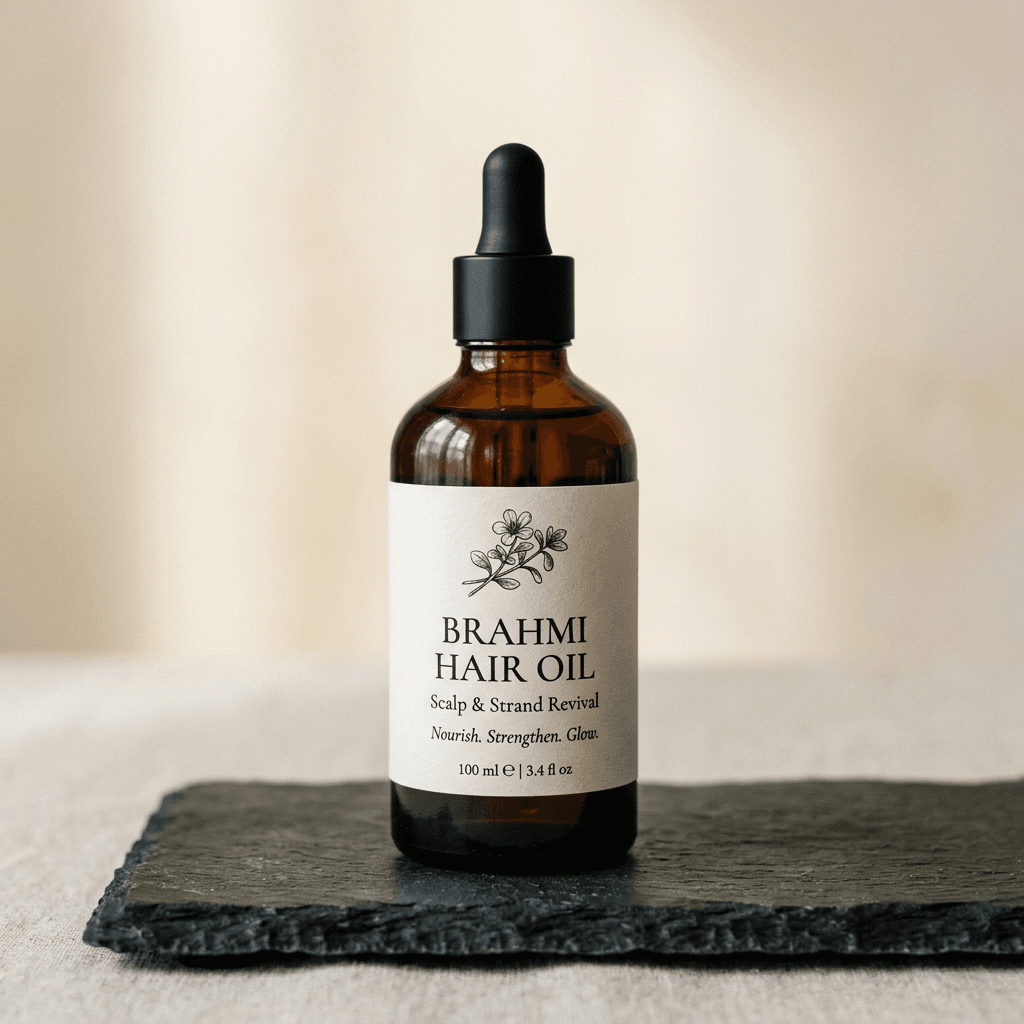
The oil we formulate for exactly this is our Brahmi Hair Ritual Oil — cold-pressed coconut and slow-steeped Brahmi (Bacopa Monnieri), the classical *medhya rasayana* herb shown in research to stimulate growth at the dermal-papilla level, blended with Amla, Bhringraj and Gotukola. It is deliberately warm and grounding, because that is what Vata hair fall actually needs.
4. Be patient on the hair cycle's terms A hair follicle works on a 90-day clock. Anyone promising results in a week is selling you something. With consistent inside-and-outside care, most Vata hair-fall patients see the shedding slow noticeably by week 6, and new growth by week 10–12. The people who succeed are simply the ones who did not quit at week 3.
How to know your exact pattern
Everything above assumes Vata-driven hair fall, which is the most common — but not the only — pattern. Pitta-type hair fall (with scalp heat, early greying, inflammation) needs a cooling approach. Kapha-type (oily scalp, heavy dandruff) needs a clarifying one. Using the wrong one slows you down.
If you have been guessing — and getting it wrong — this is exactly what a short Ayurvedic reading is for. In 15 minutes, Dr. Hashani Perera can identify which pattern is actually driving your hair fall and tell you the precise next step for *your* constitution, not a generic one. It is free, and there is no obligation to buy anything.
Your hair has been trying to tell you something. Once you listen at the root, it stops falling — and starts growing back.
Dr. Perera recommends for Vata types
From the Chandayu ritual

Not sure which pattern is yours?
Find your exact root cause in 15 minutes — free
Dr. Hashani Perera BAMS will identify what is really driving your concern and give you the precise next step for your constitution. No cost, no obligation.
Book Your Free Reading